Some links on our site may earn us a commission at no extra cost to you. Learn more.
A convertible car seat that fits a tiny two-door hatchback isn’t the same seat that fits a family of four squeezing three kids across one bench. If you only remember one thing from this guide, make it this: the Diono Radian 3RXT (about $299.99) is the narrowest pick here at 17 inches, which matters most for small cars and three-across installs; the Graco Extend2Fit 3-in-1 (about $269.99) is the least expensive seat that still stretches from a newborn’s rear-facing days through a booster; and the Evenflo Gold Revolve360 Extend (about $499.99) rotates up to 180° so you’re not leaning into a back seat to buckle a squirming toddler. The other three — Britax Poplar, Nuna RAVA, and Clek Foonf — solve narrower, but real, problems: fast reinstalls, a longer-lasting no-rethread harness, and a rigid-LATCH, low-profile build.
Every seat sold in the United States, including all six below, has to meet the same federal crash-test standard — Federal Motor Vehicle Safety Standard 213 (FMVSS 213). That means nothing in this guide ranks one seat as “safer” than another. What actually differs between these seats is how easily they install in your specific vehicle, how long they’ll fit your kid before the weight or height limit runs out, how much they cost, and how much of a hassle the cover is to clean after a juice-box incident. That’s the lens we used to sort six real, currently-sold convertible car seats into the family situations they solve best.
Published August 5, 2026. Updated August 5, 2026.
Which Situation Matches Which Convertible Car Seat?
Before the deep dives, here’s the short version. Match your situation on the left to the pick on the right, then jump to that seat’s section for the full breakdown of must-haves, nice-to-haves, and honest dealbreakers.
- Small car or three kids across one bench: Diono Radian 3RXT — 17 inches wide, the narrowest seat here.
- Tightest budget, want one seat from infancy to booster: Graco Extend2Fit 3-in-1 — about $269.99 and converts three ways.
- Bad back, low SUV, or a solo parent buckling a toddler alone: Evenflo Gold Revolve360 Extend — rotates so you load facing the door.
- Shuffling the seat between two cars or a grandparent’s car often: Britax Poplar — ClickTight install, no seatbelt threading.
- Longer, taller toddler who’s outgrowing seats by height, not weight: Nuna RAVA — no-rethread harness with a tall forward-facing height range.
- Want the smallest footprint eating into front-seat legroom, and don’t mind paying for it: Clek Foonf — rigid-LATCH install and a compact rear-facing base.
Table of Contents
- Which Situation Matches Which Convertible Car Seat?
- The 6 Convertible Car Seat Picks, Explained
- Original Data: Cost Per Year, Based on Each Seat’s Published Lifespan
- Side-by-Side Spec Comparison
- A Note on Installation and Getting It Checked
- How We Researched This Guide
- Frequently Asked Questions
- Related Guides
The 6 Convertible Car Seat Picks, Explained
Each of these is a real, currently-sold convertible seat — meaning it installs rear-facing for infants and toddlers, then converts to forward-facing with a harness as your child grows, and in some cases converts again into a booster. Prices below are approximate list prices as of publication; retailers discount these constantly, so treat them as a starting point, not gospel.
1. Graco Extend2Fit 3-in-1 — Best for Budget-Conscious Families Who Want One Seat, Full Stop
At about $269.99, the Extend2Fit 3-in-1 is the least expensive seat on this list, and it’s also the only one here that converts three full ways — rear-facing (4 to 50 lb), forward-facing with a harness (26.5 to 65 lb), and then a highback booster (40 to 100 lb, 43 to 57 inches), per Graco’s published specs. Its signature feature is a four-position panel that pulls out to add up to 5 inches of legroom for a rear-facing child whose feet are cramping against the vehicle seatback — a common reason parents flip a toddler forward-facing before they have to.
- Must-have: A seat that doesn’t need replacing again until grade school, for under $300.
- Nice-to-have: The legroom extension panel, which buys extra rear-facing time without a bigger seat shell.
- Dealbreaker for some: At 19-plus inches wide in some configurations, it isn’t the pick for tight three-across installs — that’s Diono’s job on this list.
- Best for: Families who want the lowest total cost per year of use and don’t need to fit three seats across one row.
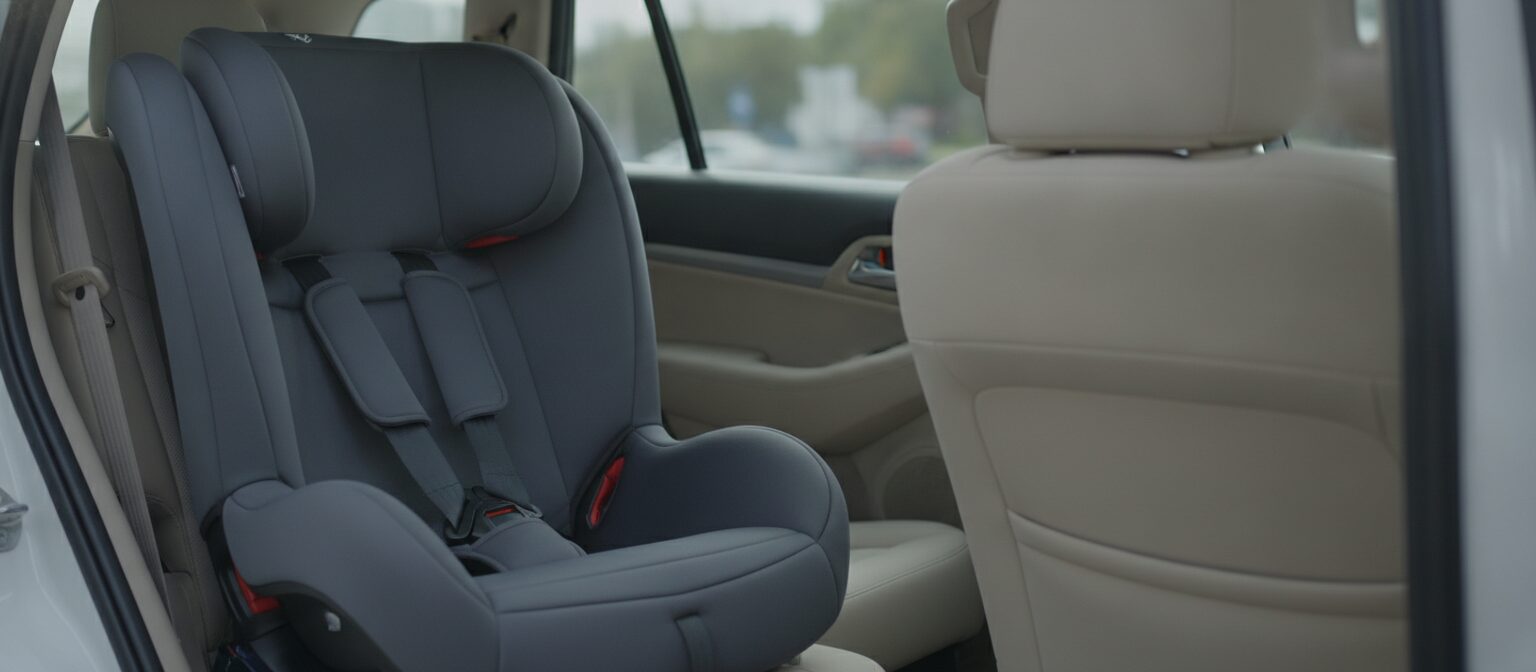
2. Diono Radian 3RXT — Best for Small Cars and Three-Across Installs
The Radian 3RXT is built around a steel frame inside a 17-inch-wide shell — narrow enough that three of them can, per Diono’s published fit guidance, sit across a back seat that’s roughly 51 inches wide. That makes it the go-to for twins, triplets, or a family with three car-seat-age kids who all need to ride in the same row. It runs about $299.99 and covers rear-facing up to 50 lb / 44 inches, forward-facing to 65 lb, and then a booster mode up to 120 lb / 57.1 inches — the highest published booster ceiling of any seat in this roundup.
- Must-have: A genuinely narrow shell — this is the number that solves the three-across problem, not marketing language.
- Nice-to-have: Diono markets the Radian line as “10 years, 1 car seat,” reflecting the steel frame’s longer published lifespan.
- Dealbreaker for some: The narrow shell means less side padding than some of the plusher seats here — fine for most kids, but worth test-sitting if yours runs long-legged or broad.
- Best for: Small sedans, minivans doing a 3-across middle row, and families who’d rather buy once and keep the same seat into elementary school.
3. Evenflo Gold Revolve360 Extend — Best for Parents Buckling a Toddler Solo
This is the rotating seat: the shell spins up to 180° so you can turn it to face the open door, load your child, then rotate it back into the correct rear- or forward-facing position and lock it in. If you’ve ever thrown out your back leaning across a back seat to buckle a toddler who’s decided to arch away from you, this is the feature that fixes that specific problem — not a safety upgrade, just a genuinely different loading experience. It lists around $499.99 and covers rear-facing 4 to 50 lb (17 to 48 inches) and forward-facing 30 to 65 lb (35 to 49 inches), per Evenflo’s published specs, with a booster mode to 120 lb.
- Must-have: Rotation that actually locks solidly in every position — Evenflo’s SensorSafe reminder and rotation lock are built around this.
- Nice-to-have: A booster ceiling of 120 lb, matching Diono’s for the longest usable stretch in this group.
- Dealbreaker for some: It’s the second-most expensive seat here and one of the heaviest to move between vehicles.
- Best for: A solo parent, anyone with back or shoulder limitations, or a two-door coupe where reaching into the back seat is awkward.

4. Britax Poplar — Best for Families Who Move the Seat Between Cars Often
The Poplar uses Britax’s ClickTight system: you open the seat like a car door, thread the vehicle seat belt through, then close it — the closing motion tensions the belt for you, instead of you kneeling on the seat to crank it tight by hand. For families who split custody, hand the seat to grandparents on weekends, or swap it between two cars during the week, that install speed adds up fast. It runs about $349.99 and covers rear-facing up to 50 lb / 49 inches and forward-facing up to 65 lb, per Britax’s specs and a seat-specific review from Car Seats for the Littles.
- Must-have: A fast, repeatable install for anyone who reinstalls more than once or twice a year.
- Nice-to-have: A 49-inch rear-facing height ceiling, among the taller limits here, for a long-torso toddler.
- Dealbreaker for some: No booster mode — the Poplar is strictly a rear-facing/forward-facing convertible, so you’ll need a separate booster later.
- Best for: Two-household families, frequent grandparent pickups, or anyone who dreads reinstalling a seat from scratch.
5. Nuna RAVA — Best for a Tall Toddler Who Outgrows Seats by Height First
The RAVA uses a no-rethread harness, so instead of unbuckling and re-threading straps through a new slot every time your child grows, you adjust the harness height with one handle while the straps stay clipped in. Combined with a forward-facing height range that runs to 49 inches, per Nuna’s published FAQ, it’s a solid fit for a toddler who’s tall for their weight and tends to hit height limits before weight limits. It typically runs around $429.99 depending on fabric and retailer, and covers rear-facing 5 to 50 lb (18 to 49 inches) and forward-facing 30 to 65 lb (34 to 49 inches).
- Must-have: The no-rethread harness, which saves real time during growth spurts.
- Nice-to-have: GREENGUARD Gold–certified fabric, relevant to parents tracking indoor air-quality claims on nursery and car-seat textiles.
- Dealbreaker for some: It’s priced above the Graco and Diono picks without a booster mode built in.
- Best for: A taller-than-average toddler and parents who want fewer harness adjustments over the seat’s life.
6. Clek Foonf — Best for a Tight Front-to-Back Legroom Squeeze
The Foonf installs with rigid LATCH connectors that click directly into the vehicle’s lower anchors — no webbing to pull tight, and per Clek’s product materials, a compact rear-facing footprint designed to leave more legroom for whoever’s sitting in front of it. That’s the real problem it solves: small hatchbacks and compact sedans where a bulky rear-facing seat pushes the front seat uncomfortably forward. It’s the priciest pick here at about $559.99, covering rear-facing 14 to 50 lb (25 to 43 inches) and forward-facing 26.5 to 65 lb (30 to 49 inches).
- Must-have: Rigid LATCH for a fast, consistent install without wrestling with webbing.
- Nice-to-have: A steel-and-aluminum interior structure that Clek backs with a published 9-year lifespan from the date of manufacture.
- Dealbreaker for some: It’s the most expensive seat on this list, and rigid LATCH only works within the vehicle’s weight limit for lower anchors — check your owner’s manual.
- Best for: Compact cars where front-seat legroom is already tight, and families who want the fastest possible LATCH install.
Original Data: Cost Per Year, Based on Each Seat’s Published Lifespan
Sticker price alone is misleading, because these seats don’t last the same number of years. We took each seat’s approximate list price and divided it by the expiration window each manufacturer publishes for that model — the number of years from the date of manufacture printed on the seat’s own label before it must be retired. This is our own calculation, based on manufacturer-published prices and expiration guidance; it assumes you use the seat for its full published lifespan, which won’t match every family’s actual timeline.
| Seat | Approx. Price | Published Lifespan | Cost Per Year (Our Calculation) |
|---|---|---|---|
| Graco Extend2Fit 3-in-1 | $269.99 | 10 years (steel-reinforced belt path, per Graco’s expiration policy) | $27.00 |
| Diono Radian 3RXT | $299.99 | 10 years (steel-frame Radian line, per Diono) | $30.00 |
| Britax Poplar | $349.99 | 10 years (per seat label; Britax’s general range is 6–10 years by model) | $35.00 |
| Nuna RAVA | $429.99 | 10 years (per date-of-manufacture label) | $43.00 |
| Evenflo Gold Revolve360 Extend | $499.99 | Up to 10 years (per Evenflo’s product materials) | $50.00 |
| Clek Foonf | $559.99 | 9 years (per Clek’s official support documentation) | $62.22 |
Two caveats worth sitting with. First, the clock starts at manufacture, not purchase — a seat that sat in a warehouse for eight months already has eight months shaved off its usable life, so always check the actual date on the label of the unit you receive. Second, cost per year isn’t the only number that matters: the Extend2Fit and Radian 3RXT both come out cheapest per year here partly because they also convert into boosters, stretching real-world use well past the forward-facing harness stage, while the Poplar and RAVA are strictly rear/forward-facing convertibles that you’ll eventually pair with a separate booster.
Side-by-Side Spec Comparison
| Seat | Rear-Facing Range | Forward-Facing Range | Booster Mode | Width | Approx. Price |
|---|---|---|---|---|---|
| Graco Extend2Fit 3-in-1 | 4–50 lb, up to 49″ | 26.5–65 lb, up to 49″ | 40–100 lb, 43–57″ | Standard | $269.99 |
| Diono Radian 3RXT | Up to 50 lb, up to 44″ | Up to 65 lb | 40–120 lb, up to 57.1″ | 17″ (narrowest) | $299.99 |
| Britax Poplar | 5–50 lb, up to 49″ | Up to 65 lb | None | 17″ | $349.99 |
| Nuna RAVA | 5–50 lb, 18–49″ | 30–65 lb, 34–49″ | None | Standard | $429.99 |
| Evenflo Gold Revolve360 Extend | 4–50 lb, 17–48″ | 30–65 lb, 35–49″ | Up to 120 lb, 57″ | Standard (rotating base) | $499.99 |
| Clek Foonf | 14–50 lb, 25–43″ | 26.5–65 lb, 30–49″ | None | Compact (rigid-LATCH) | $559.99 |
All figures above are pulled from each manufacturer’s own published specifications as of publication. Limits and pricing change when brands update a model year, so confirm current numbers on the manufacturer’s site or the seat’s own label before you buy.
A Note on Installation and Getting It Checked
None of the differences above are about which seat performs better in a crash — all six meet the same FMVSS 213 federal standard, and how a seat performs depends heavily on correct installation and use, not on which brand made it. What actually varies is how easy each seat is to install correctly in your specific vehicle, which is exactly why installation help exists.
Whichever seat you choose, read both the seat’s own manual and your vehicle’s manual before installing — they’ll tell you which seating positions and anchor points are approved for your specific car. After that, NHTSA maintains a searchable directory of free car-seat inspection stations staffed by certified Child Passenger Safety (CPST) technicians, and many local police and fire stations run periodic car-seat-check events. A technician can confirm your install and answer questions specific to your vehicle and seat combination — it’s a free resource worth using even if you’re confident you got it right.
How We Researched This Guide
We didn’t physically test-install these seats. Instead, we synthesized each manufacturer’s published weight, height, and expiration specifications directly from their current product pages and support documentation, cross-checked pricing across multiple current retail listings, and read verified owner and reviewer consensus from independent car-seat review sites, including Car Seats for the Littles and Safe in the Seat, to understand real-world install experience and fit. For broader guidance on rear-facing duration and installation, we relied on published guidance from the National Highway Traffic Safety Administration (NHTSA) and the American Academy of Pediatrics (AAP), both named in-text above where relevant. Prices are approximate, current as of publication, and change frequently — confirm the latest price with the retailer before buying.
See our editorial standards for more on how we select and vet products.
Frequently Asked Questions
What’s the difference between a convertible car seat and an infant car seat?
An infant seat is rear-facing only and typically detaches to click into a stroller, but it’s outgrown within the first year or two. A convertible seat, like the six here, installs rear-facing first and then converts to forward-facing (and sometimes a booster) as your child grows, so one seat can last from infancy well into grade school.
How long can a child stay rear-facing in a convertible seat?
It depends on the seat’s rear-facing weight and height limits, which range from about 44 to 50 inches and up to 50 lb across the seats above. The American Academy of Pediatrics recommends keeping children rear-facing as long as they fit within their seat’s specific rear-facing limits, rather than switching them forward-facing at a particular age.
Do convertible car seats expire, and how do I find the date?
Yes. Every seat in this guide has a published expiration window, typically 9 to 10 years from its date of manufacture per the brands’ own documentation, printed on a label on the seat itself, usually on the bottom or back of the shell. Materials degrade and safety standards evolve over that time, so check your specific seat’s label rather than assuming a number from this article.
Can I install a convertible car seat with just the seatbelt, or do I need LATCH?
Either works — every seat here can install using the vehicle’s seatbelt or the LATCH (Lower Anchors and Tethers for Children) system, per each manufacturer’s manual. Some seats, like the Clek Foonf, use a rigid-LATCH connector that clicks in without webbing, which can be faster, but both methods are approved installation paths when done correctly.
Should I have my installation checked by a professional?
It’s a good idea regardless of how confident you feel. NHTSA maintains a directory of free inspection stations staffed by certified Child Passenger Safety technicians, and many local police and fire departments host car-seat-check events where a technician reviews your specific install in your specific vehicle at no cost.
Do convertible car seats fit three-across in a back seat?
Some do, some don’t — it depends on both the seat’s width and your vehicle’s back-seat width. The Diono Radian 3RXT is built specifically for this at 17 inches wide, the narrowest seat in this guide, but confirm fit with your specific vehicle’s back-seat measurements before assuming any seat will fit three-across.
How much should I expect to spend on a convertible car seat?
Across the six seats in this guide, list prices range from about $269.99 to $559.99, and that spread roughly tracks features like rotation, rigid LATCH, and no-rethread harnesses rather than one seat being more protective than another. All six meet the same federal FMVSS 213 standard regardless of price.
Can I use a convertible car seat for a newborn?
Most of the seats above accept a newborn starting around 4 to 5 lb rear-facing, per their published minimums, so yes — many families skip a separate infant seat entirely and start with a convertible. Just confirm your specific newborn meets the seat’s minimum weight and that the harness can be adjusted snugly enough for a smaller baby, per the seat’s manual.
Related Guides
For more picks in this category, browse our Parenting & Baby Essentials archive. If you’re also outfitting the back seat for longer drives, our guides to the best baby bottle warmers and sterilizers and the best backseat car organizers for road trips with kids cover two more pieces of the same puzzle.